Business ERP
A proven open-source ERP, chosen, configured, branded and hosted by RAIN: Dolibarr ERP/CRM 22.0.3 shaped into an all-in-one French-language business system for SMEs — the fast option beside the custom-built RIVER ERP.
A proven open-source ERP, chosen, shaped and run by RAIN.
Not every business needs an ERP written from scratch. Many small and mid-sized companies need the same core on day one — a clean customer file, quotes that turn into orders and invoices, stock that matches the shelves, bank and cash positions they can trust, and an HR corner for leave and expense claims. Business ERP is RAIN Design Studio's answer for them: a deployment of Dolibarr ERP/CRM 22.0.3, the long-established open-source ERP, that RAIN selected, configured, branded, extended through module choice and workflows, and hosts. RAIN did not write Dolibarr; the value is in the choices made around it — and in knowing when it is the right tool.
The live instance runs at facture.mrzakaria.com under the RAIN mark, with the browser title “Facture | MrZaKaRiA” and a fully French interface. Out of the 83 modules Dolibarr ships, 57 are switched on — enough to run sales, purchasing, billing, banking, stock, projects, support and HR from one login, and no more than a small team needs to learn. Everything else stays off, so menus stay short and forms stay readable. The result is a thirteen-section top menu that reads like the way a French-speaking SME already talks about its work: Accueil, Tiers, Produits | Services, Projets, Commerce, Facturation | Paiement, Banques | Caisses, Comptabilité, GRH, Documents, Agenda, Tickets and Outils.
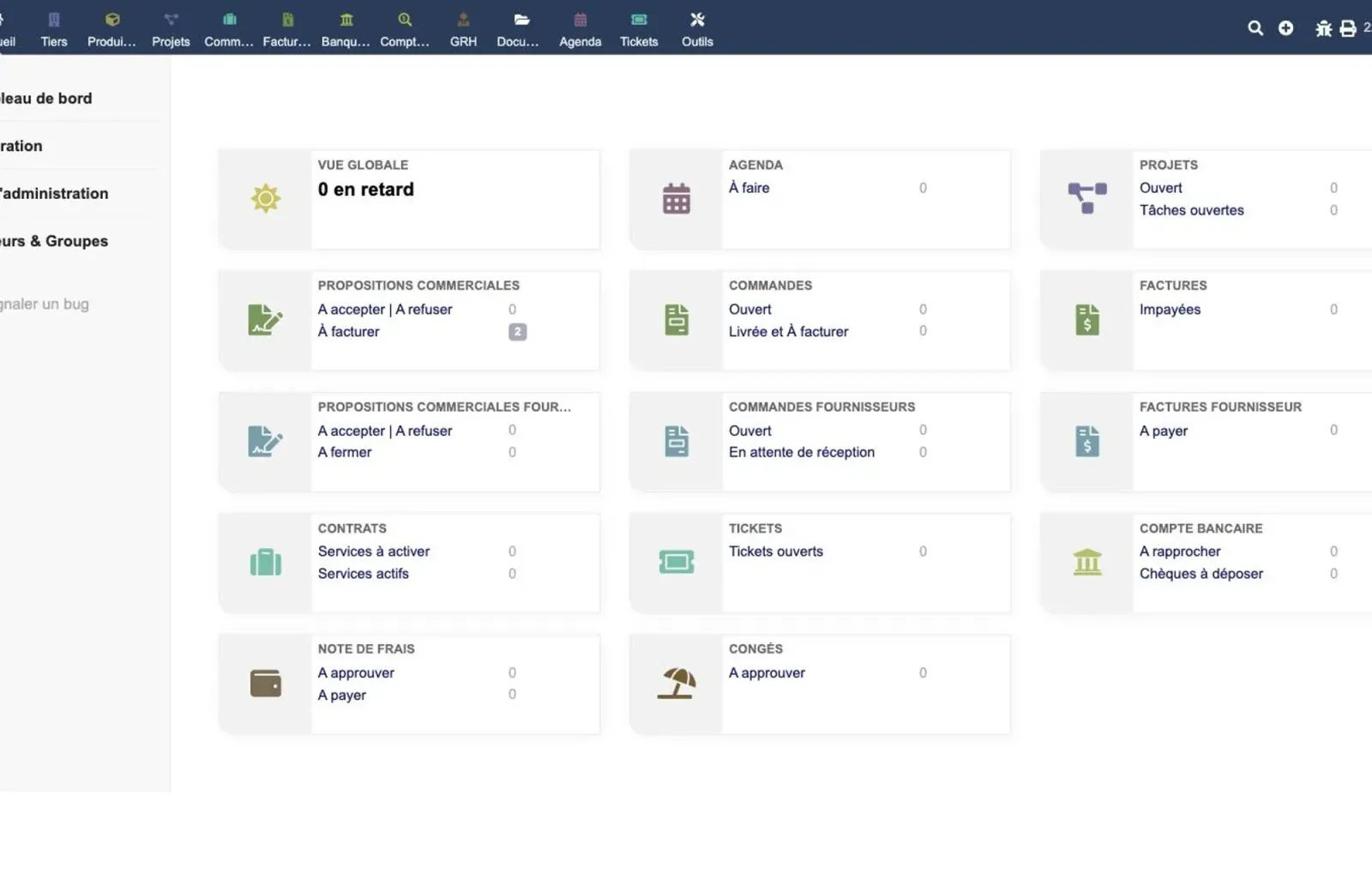
The setup is local by default. Amounts are kept in Moroccan dirhams (MAD), documents and screens are in French, and the inter-module workflow is configured so that one step leads naturally to the next — a signed proposal becomes an order, an order becomes a shipment and an invoice, and the invoice lands in a bank or cash account when it is paid. The home screen opens on a dashboard of KPI boxes covering the overview, agenda, projects, proposals, orders, invoices, supplier proposals, supplier orders and supplier invoices, contracts, tickets, the bank account, expense reports and leave, with monthly charts for customer orders, supplier invoices and customer invoices underneath.
Business ERP sits next to RIVER ERP in the RAIN portfolio, and the two answer different questions. RIVER ERP is RAIN's own custom-built, Morocco-first platform — the choice when a business needs DGI e-invoicing, Moroccan payroll, a restaurant POS or a workflow no package covers. Business ERP is the fast, proven option: an open-source core with a large community, no licence fee per user, an open REST API, and a configuration a team can start using in days rather than months. The instance is in light, early use — demo and starter data — so this case study describes what was configured, not business results.
Modules enabled, out of Dolibarr's 83
Top-menu sections, in French
KPI boxes on the home dashboard
Dolibarr ERP/CRM release in production
Fifty-seven modules, one ledger of customers, products and money.
Choose the platform, not just the features
Dolibarr was selected because it is open source, modular, mature and self-hostable: the code is public, there is no per-user licence, the data stays on a server the business controls, and a large community keeps the core moving. RAIN's job was to decide which parts of it a small company actually needs.
Module curation: 57 of 83
Every module adds screens, fields and permissions. Switching on 57 and leaving 26 off keeps the product complete for sales, purchasing, billing, stock, projects, support and HR — while hiding everything a small team would only trip over. Modules can be switched on later without a migration.
A menu that follows the business
The result of that curation is a thirteen-section French top menu, from Accueil to Outils, where each entry maps to a real job — Tiers for the customer and supplier file, Commerce for the sales cycle, Facturation | Paiement for billing, Banques | Caisses for money, GRH for people.
Connected workflows between modules
The inter-module workflow module links the steps so documents carry forward: proposal to order, order to shipment and invoice, invoice to payment and bank entry. Margins are calculated from cost prices, amounts are written out in words on documents, and every record keeps its linked files and events.
Local setup: French and MAD
The interface and documents are in French and amounts are kept in Moroccan dirhams. Accounting runs in Dolibarr's simplified mode — turnover and VAT reports built from invoices and payments — which suits a small business working with an outside accountant, without the weight of a full double-entry setup.
RAIN-branded, RAIN-hosted
The RAIN mark sits in the header and the browser title reads “Facture | MrZaKaRiA”, so the ERP looks like part of the studio's own toolset rather than a stock install. RAIN hosts the instance itself, at facture.mrzakaria.com, rather than renting a per-user cloud subscription.
Open to the rest of the stack
The REST API and webhooks let websites, stores and scripts read and write the same records; LDAP connects user accounts to a directory; DAV exposes the document store; an email collector turns incoming mail into records; and scheduled jobs run reminders and housekeeping on their own.
Extend without forking
When a business needs something Dolibarr does not do, the Module Builder generates a new module beside the core instead of patching it. Custom objects, screens and fields stay separate, so the core can still be upgraded to the next Dolibarr release.
Upgrades rehearsed on real data
RAIN treats Dolibarr upgrades as migrations. On a separate Moroccan deployment, a database first installed on Dolibarr 13 was carried from 18.0.1 to 23.0.3 and from MariaDB 10.11 to 11.8, growing from 370 to 398 tables. Scripts compared every table's columns with the upstream Dolibarr 23.0 schema and diffed the enabled-module flags, and five core modules the upgrade had dropped — third parties, orders, invoices, suppliers and bills of materials — were restored in a patched dump.
A dashboard that opens on the day's work
The home screen gathers fourteen KPI boxes — from open proposals and unpaid invoices to tickets, bank balance, expense reports and leave — and three monthly charts for customer orders, supplier invoices and customer invoices, so the owner sees what needs attention before opening a single menu.
From the first quote to the bank statement.
Sales, purchasing, billing, banking, stock, projects, support and HR in one French-language ERP, with the integration and automation tools to connect it to everything else. Below are the enabled modules, area by area. Hover any module to see what it does.
- Third parties
- Commercial proposals
- Sales orders
- Shipments
- Interventions
- Partnerships
- Margins
- Suppliers
- Supplier proposals
- Receptions
- Incoterms
- Invoices & credit notes
- Special taxes & expenses
- Banks & cash
- Bank transfer payments
- Direct debit
- Loans
- Donations
- Accounting (simplified)
- Products
- Services
- Stock
- Lot / serial numbers
- Product variants
- Barcodes
- Workstation
- Projects / opportunities
- Events / agenda
- Resources
- Ticket manager
- Knowledge base
- Users & Groups
- HRM
- Leave requests
- Expense reports
- Recruitment
- Salaries
- DMS (GED)
- WYSIWYG editor
- Emailing
- Email collector
- Business-event notifications
- Social networks
- One-click printing
- Receipt printers
- Number Words
- REST API / web services
- Webhooks
- LDAP
- DAV
- Scheduled jobs
- Inter-module workflow
- Data import
- Data export
- Module Builder
- AI module
57 of Dolibarr's 83 modules switched on, across thirteen menu sections — one login, one database, open source.
The fast, open-source option — and when to go custom.
Business ERP wins on time to value and cost of ownership. Where a business needs deep Moroccan compliance or a workflow no package covers, RAIN recommends a custom build instead — and says so.
| Business ERP | Odoo | Sage | RIVER ERP (custom) | |
|---|---|---|---|---|
| Open-source core | ✓ | ○ | — | — |
| No per-user licence fees | ✓ | ○ | — | ✓ |
| Live in days, not months | ✓ | ○ | ○ | ○ |
| CRM: proposal → order → invoice | ✓ | ✓ | ○ | ✓ |
| Multi-warehouse stock, lots & serials | ✓ | ✓ | ○ | ✓ |
| Projects, tickets & knowledge base | ✓ | ○ | — | ○ |
| Leave, expense reports & recruitment | ✓ | ✓ | ○ | ○ |
| Full double-entry accounting (CGNC) | ○ | ○ | ✓ | ✓ |
| Moroccan payroll (CNSS / IR) | — | ○ | ✓ | ✓ |
| Moroccan DGI e-invoicing | — | ○ | ○ | ✓ |
| Manufacturing & POS | ○ | ✓ | ○ | ✓ |
| REST API & webhooks | ✓ | ✓ | ○ | ✓ |
| Self-hosted on your own domain | ✓ | ✓ | ○ | ✓ |
| Shaped around one exact workflow | ○ | ○ | — | ✓ |
An all-in-one ERP in days, with a clear path beyond it.
Business ERP gives a small or mid-sized company one place for its customers, quotes, orders, invoices, payments, stock, projects, support tickets, leave and expense claims — in French, in dirhams, under its own brand and on a server it controls. Because the core is open source and widely used, there is no per-user licence to grow into, no lock-in to a single vendor, and a long track record behind every module that is switched on.
It also makes RAIN's ERP advice honest. Some businesses are best served by a proven package configured well; others need a platform built around them. With Business ERP and RIVER ERP side by side, RAIN can recommend either — and move a company from one to the other when it outgrows the first. The instance at facture.mrzakaria.com is in light, early use with demo and starter data, so we make no customer, revenue or volume claims for it; what it shows is the configuration, branding, upgrade discipline and hosting RAIN brings to an open-source ERP. Deployments are quoted to scope after a free 15-minute call, and custom builds like RIVER ERP are Custom Projects from $10,000.
Business ERP — FAQ
Business ERP is RAIN Design Studio's deployment of Dolibarr ERP/CRM 22.0.3, the open-source ERP. RAIN selected it, enabled 57 of its 83 modules, configured the workflows, branded it and hosts it, so a small or mid-sized company can run sales, purchasing, billing, banking, stock, projects, support and HR from one French-language system.
No. Dolibarr is an independent open-source project with its own community. RAIN's work is the selection, module choice, workflow configuration, French and Moroccan setup in dirhams, branding, upgrades and hosting around it.
57 modules are enabled, including third parties, commercial proposals, sales orders, shipments, interventions, suppliers, receptions, invoices and credit notes, banks and cash, simplified accounting, products, stock with lots and serials, projects, agenda, tickets, knowledge base, leave, expense reports, recruitment, document management, the REST API and webhooks.
Choose Business ERP when you need a proven all-in-one ERP quickly and your processes fit a standard package. Choose RIVER ERP, RAIN's custom-built Morocco-first platform, when you need DGI e-invoicing, CNSS and IR payroll, a restaurant POS or a workflow no package covers.
Odoo is broader, but many of its apps are in the paid per-user Enterprise edition; Business ERP covers the SME core on a fully open-source base. Sage is stronger for formal Moroccan accounting and payroll, while Business ERP adds CRM, projects, tickets, stock and HR in one system with an open API.
Deployments are quoted to scope after a free 15-minute call, depending on modules, data import and extensions. Custom builds like RIVER ERP are Custom Projects from $10,000; RAIN's website packages are Website Design at $7,500 and Website + SEO at $15,000.